


For access to safe and healthy housing for all in Kibera – Phase 2
State : In progress | Number of beneficiaries : 5,350 people
Project duration : 3 years
Location : Kibera slum, Nairobi, Kenya
Local partner
The Kibera Girls Soccer Academy (KGSA), the first Kenyan partner of PADEM (2007), was originally an initiative of a nairobian who grew up in Kibera: Abdul Kassim, telecommunications engineer. Based on his life experiences, he wanted to launch an initiative to promote gender equality and break gender norms in Kenya.
KGSA today opened a free secondary school for 130 girls aged 12-18. Aware that gender imbalances are omnipresent in Kibera (early marriages and pregnancies, dropping out of school, etc.), the NGO has founded a program for integrating girls through the practice of football there. KGSA also operates a smaller coeducational school.
Thanks to these actions, KGSA has been able to create a safe living space for the young girls of Kibera and has been recognized by the community. The young women were able to strengthen their education and are now an example of change for other young girls.
In addition, KGSA has experience in housing projects, notably with UN Habitat (the United Nations Habitat program). The NGO was able to capitalize on previous achievements to learn lessons. She also built a school and this is another notable building experience.
Context
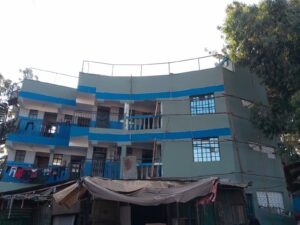
Kibera is estimated to be the largest shantytown in Africa, with an official population of 170,000 permanent residents and up to 700,000 temporary residents, covering an area of 256 hectares. In the heart of Nairobi, the Kibera shantytown is a colonial legacy, originally populated by Nubians temporarily settled by the British forces. With no title deeds for almost a century (1928), the inhabitants live in precarious dwellings that are difficult to improve in the long term and are rapidly deteriorating. Local and traditional authorities sometimes grant Land use rights, but this does not prevent possible eviction by the government if a development project is adopted. To date, no large-scale project has come to fruition due to the highly conflictual social dynamics and the failure to take into account the needs of the resident population.
Over the last ten years or so, the government’s efforts have nevertheless enabled access roads to be built, facilitating essential services and the slow improvement in living conditions and security. Large-scale government initiatives to build social housing have failed, however, and middle-class families, leaving the poor residents of Kibera without a solution, quickly occupied the homes built on the outskirts of Kibera. Access to drinking water is still a problem, and Kibera suffers particularly badly from droughts.
In Kibera, the sanitation infrastructure (drainage, sewers, and toilet blocks) is still inadequate and suffers from a lack of regular maintenance due to a lack of effective and sustainable community organisation. The lack of systematic solid waste collection exacerbates the problem, with waste clogging up drains and creating numerous unhealthy areas, and even pollution in homes during the rainy season. The lack of public lighting is a source of insecurity, particularly with regard to gender-based violence and the risk of child abuse, in accessing basic services after 6.30pm.
The mission
Overall objective: To contribute to a sustainable improvement in the living conditions of the most vulnerable people in Kenya.
Specific objective: To promote the rehabilitation and participative management of dignified, safe and healthy habitats.
Activities
- Operation of KGSA Social House with an affordable and sustainable system based on solidarity
- Set up of community higiene and sanitation services for neighbourhoods: construction / renovation of 2 sanitary blocks for the community as well as water supply equipment (taps, pipes, electric water pumps), community sensitization on questions of hygiene, access to water and sanitation, improvement of the urban drainage system and establishment of community waste collection managed by young people from the slum (equipment (dumpsters, transporter, clothing, etc.) and training of young people), capitalization
- Inhabitants support and training in self-rehabilitation of their precarious dwellings in the villages of Makongeni and Gatwekera
Beneficiaries
5,350 direct beneficiaries including:
- 57 families relocated or whose housing will be renovated
- 600 families who will benefit from an improvement in the sanitation system (drainage and waste management), around 3,600 individuals
- 1,200 residents of Makongeni who will benefit from cleaner streets
- 3 youth groups will be trained and they will develop services to their community