


For access to quality education and housing for all in Mathare and Busia – Phase 2
Status : In progress | Number of beneficiaries : 8,000 people
Project duration : 3 years
Location : Mathare slum, Nairobi, Kenya and Rural community of Budalangi, Busia County, Kenya
Local partner
LEK (Linda Elimisha Kike) is a non-profit institution, established in 2010, intended to provide advocacy, women and youth empowerment programs and education opportunities to the most vulnerable children in the community of Mathare slum. It is a community-based organization registered with the Government of Kenya with registration number KAS / CBO / 5/4/2012/495. Its leadership is made up of two members (Leah Nyalobo and Sarah Rono) approved to take on leadership roles by the Government of Kenya which has mandated them through the registration certificate above.
LEK has already implemented several projects in Mathare, including:
- The children’s school sponsorship program,
- The program Safisha Kijiji (Keep Your Slum Clean),
- The project for the return to school of all girls,
- The entrepreneurial skills development project,
- The project for the empowerment of children through sport.
The issue of habitat has also been addressed by LEK before. The association implemented a housing renovation project for widows and the most vulnerable families in Busia County, eastern Kenya. This project was made possible through local fundraising and the collaboration of local county authorities. Together, they have also set up temporary reception structures, in particular for flood victims. The members of LEK have since worked in close collaboration with these authorities who ask them in particular to deploy counseling services to populations who are victims of GBV (gender-based violence). GBV being very present in the area, and impacting the daily life and living conditions of the populations.
The first phase of this project supported families in setting up income-generating activities in Busia and Mathare, building a 3-storey school in the Mathare shantytown for 320 children and housing 9 families. Combating and raising awareness of gender-based violence was also a key focus throughout the first phase.
In Busia, the first project enabled 39 families to be trained in self-renovation or self-construction of their homes, making them resistant to the frequent flooding on the shores of Lake Victoria. The renovation of communal sanitary blocks has also helped to improve hygiene and health. In this region, the fight against gender-based violence has been accompanied by the creation of micro-credit groups. These groups have helped 50 mothers to set up income-generating activities.
Context
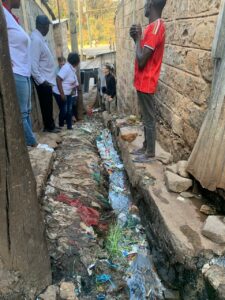
- Mathare: To the north-east of Nairobi, close to textile factories and a huge landfill site, the Mathare shanty town is home to around 500,000 people, 180,000 of whom live in the Mathare Valley. Mathare is notorious for its particularly violent gangs. Insecurity and drug and alcohol abuse among young people are particularly prevalent. Gender-based violence is very high. Victims of gender-based violence, most of whom are women who have left a violent partner with their children, are among the most vulnerable people in a very precarious situation. It is these women and children that LEK supports as a priority, while mobilising communities against gender-based violence. Little investment has been made in Mathare because the residents have settled on land that is difficult to develop and outside the development plans. Access to drinking water and electricity is very limited. In the shantytown, the sanitation infrastructure (drainage, sewers, toilet blocks) is still inadequate and suffers from a lack of regular maintenance due to a lack of effective and sustainable community organisation. The lack of systematic solid waste collection exacerbates the problem, with waste clogging up drains and creating numerous unhealthy areas, and even pollution in homes during the rainy season. The lack of public lighting is a source of insecurity, particularly with regard to gender-based violence and the risk of child abuse, in accessing basic services after 6.30pm.
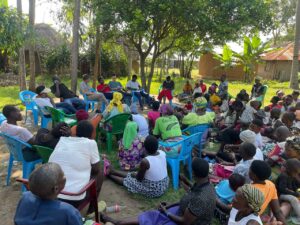
- Busia: In the south of Busia County, close to Lake Victoria, the sub-county of Mabinju is experiencing increasing flooding. Hundreds of families have lost their homes and must either move to higher ground or prepare for further flooding. The area was again affected by the heavy rains of April 2024, when the river Nzoia and the waters of Lake Victoria backed up. Many of the inhabitants have neither toilets nor washing facilities. Access to drinking water is a problem. Economic activities are mainly focused on fishing, leaving few options for women heads of household. LEK supports the Busia communities because of the high prevalence of gender-based violence and HIV/AIDS.
The mission
Overall objective: To contribute to a sustainable improvement in the living conditions of the most vulnerable people in Kenya.
Specific objectives:
Mathare: Promoting the rehabilitation and participative management of dignified, safe and sanitary housing for women victims of violence and other highly vulnerable people in the shantytowns of Mathare, as well as access to basic education for their children
Busia: Promoting the rehabilitation and participative management of dignified, safe and healthy habitats in the rural area of Busia County affected by climate change
Activities
- Provide shelter to families who are victims of gender-based violence (GBV) and develop adequate prevention capacities: creation of a pilot community group made up of 9 families vulnerable to GBV, construction of housing with safe-zone for children, sensitization and training of project stakeholders in the fight against GBV, improvement of safety and security in the slum (installation of a public solar lighting system, securing the electrical wiring system in the homes of pilot families, etc.), capitalization, construction of a school for 200 students
- Develop model hygiene practices and capacities: construction of 2 showers and 7 shared toilets for the pilot community and 4 collective sanitation facilities, community and school awareness raising on hygiene issues, improvement of the urban drainage system and establishment of community waste collection managed by slum youth (equipment (skips, transporter, clothing, etc.) and training for young people), capitalization
- Upgrade teaching methods to improve children’s school performance, strengthen child protection and fight GBV: recruitment and training of 10 competent teachers, establishment of a parent / teacher association, supply of equipment and school uniforms for 50 children, individualized monitoring of students, capacity building of the school administration for stable management and durable
- Promote positive behaviors:by practicing sports for students who have left school and by supporting 4 sports teams (boys, girls, juniors, seniors)
- Support: materially or financially 20 families to start and develop an income-generating activity (sewing equipment, tools, livestock, etc.).
Beneficiaries
8,000 beneficiaries including:
6,600 in Mathare:
- 20 teacher working and 320 schoolchildren having access to quality education
- 93 families benefitting from healthier and more sustainable housing
- 20 youth trained in electrical safety in slums
- 3 youth groups trained to run and maintain the ablution blocks
- 6,000 people educated about hygiene and GBV
1,400 in Busia:
- 85 families having self-renovated or self-reconstructed their homes
- 10 craftsmen and 15 youth trained in self-build, self-renovation and home maintenance
- 100 women, survivors of GBV having access to savings and loaning funds
- 1000 community members learning about hygiene practices